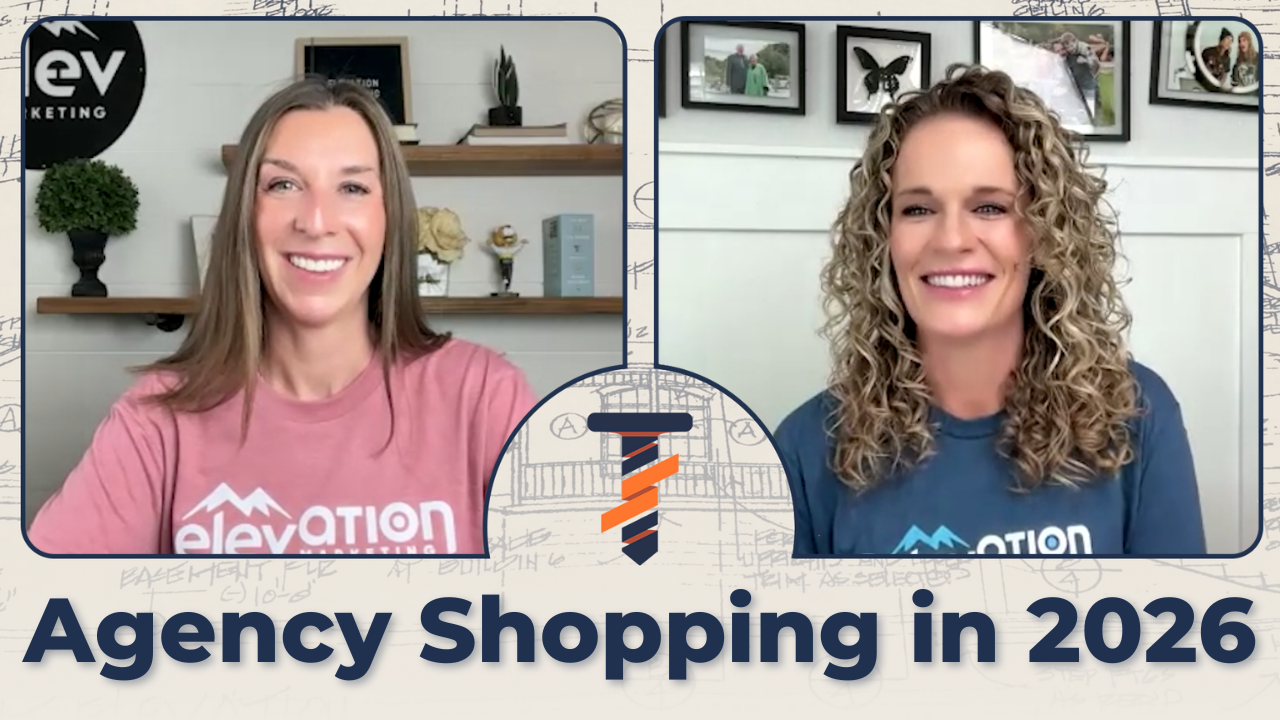
- Prefer to listen? Catch the full podcast episode here: Shopping for a Marketing Agency:
Before hiring a marketing agency for your contracting business, define your goals, demand transparent reporting, and commit to a 6–12 month plan. This guide covers how to choose the right partner, set expectations, and track ROI.
Choosing the right partner to grow your contractor business is a big deal. At Elevation Marketing™, we help contractors make smarter decisions when hiring a marketing agency.
Key Takeaways About Hiring a Marketing Agency for Contractors
- Treat marketing as a service, not a product. You need a partner, not autopilot.
- Define goals first. Lead gen, branding, or both drives your plan and budget.
- Share proof of work. Photos, reviews, and project stories fuel SEO and conversions.
- Demand clean reporting. Track booked jobs and profit by channel, not vanity metrics.
- Expect real conversations. Quarterly reviews, call audits, and clear next steps.
- Paid media needs active management. Test, shift budgets, and optimize landing pages.
- Speed to lead wins. Fast follow-up beats fancy tweaks.
- Commit to 6 to 12 months. Allow time for setup, learning, and compounding results.

Understand Your Marketing Goals Before You Hire
What do you really need from marketing, leads, branding, or both? That answer shapes everything about who you hire and how you work together.
- Lead generation: Tactics like SEO, Google Ads, Local Services Ads, and even Yelp can bring in inquiries when they are managed well and supported by strong landing pages.
- Branding: Your reputation and proof of work affect how people respond to you, and today, it also supports SEO and conversion. Unique content, reviews, photos, and real project stories matter.
- Both: Most contractors need a mix. Even if you are heavy on leads, brand proof is what helps your SEO stick and your paid traffic convert.
The biggest gap we see is a focus on tactics without a clear plan. The intention of the marketing activity should be obvious, not assumed. If you are just “doing SEO” because you heard you should, you might miss the bigger picture. Elevation Marketing™ helps contractors clarify this balance before investing in ads or SEO.
Contractors new to marketing can also review the U.S. Small Business Administration’s marketing basics for small business for a foundational overview of planning, branding, and outreach.
Ask These Questions to Clarify Your Needs
- Do I need marketing for lead gen, branding, or both?
- Is my current strategy part of a plan, or am I just chasing trends?
- What is actually working right now, and does it align with business goals?
- What will matter most in the next 12 months, more booked jobs or brand lift?
Checklist: What to Ask Before Hiring a Marketing Agency
- How do you measure ROI beyond clicks and calls?
- Can I access my Google Ads and reporting dashboards directly?
- How do you handle spam calls, vendor leads, and job-seeker submissions?
- What percentage of my monthly budget goes toward ad spend vs. management?
- How often will we meet to review progress?
Pro Tip: Save these questions for your next discovery call so you can compare agencies side by side.
Marketing as a Service vs. a Product: The Partnership Difference

Elevation Marketing™ works as a service partner, not a productized vendor. We collaborate with your team, use your proof of work, and build assets that compound over time.
| Aspect | Marketing as a Service | Marketing as a Product |
|---|---|---|
| Approach | A collaborative partnership that needs input from you, like project profiles, images, and stories. | Autopay setup, automated reports, little interaction. |
| Examples | Before and after photos from the same angle, customer pain points, original articles, and real videos. | Generic blogs are published without asking about your focus or service mix. |
| Outcomes | Builds a unique brand, supports SEO with proof of work, and improves over time with strategy. | Fails authenticity checks, looks like a clone, often a poor fit for your services or market. |
This service-first approach is core to how Elevation Marketing™ was built—around collaboration, not cookie-cutter campaigns.
What It Takes from You in a True Partnership
- Share assets consistently. Photos, videos, and quick project stories sent weekly or bi-weekly make a major difference.
- Invest time up front. On discovery calls, walk through your CRM, lead flow, photo storage, and how jobs are documented. This saves time later.
- Make it easy on yourself. If typing is hard, send voice memos. Fill out quick questionnaires at odd hours. Record notes in the truck. Your agency can turn scraps into strong content.
Common pitfall to avoid: handing blogging or all content to an admin with a full plate. It usually stalls. Give your agency raw material, then let them build. If you are buying a premium plan, such as a $3,400 per month package, your consistency is what turns that budget into booked work.
Navigating AI Tools and Automation
AI helps, but it cannot replace strategy. Use it to speed up work, not to set your whole plan. Industry research supports this balance— MIT Sloan Management Review emphasizes using AI responsibly in marketing, underscoring that technology should support human strategy, not replace it.
- Pros: AI can summarize research, tidy data, and help produce drafts. You still need to review everything for accuracy and tone.
- Cons: Poor setup leads to poor outcomes. We have seen AI answering tools mishandle calls and create a bad customer experience, including a one-star review, just because onboarding was rushed.
Tools are powerful, but they are still tools—it’s still the people that make strategy work.
Demand Transparency and Real ROI in Reporting
You deserve more than charts. Elevation Marketing™ reports on booked revenue by channel, not vanity metrics. We scrub spam and job-seeker calls, tag true leads, and align reporting to your sales process. You get dashboards you can click into, plus clear next steps.
Key elements that separate fluff from truth:
- Clean data: Someone should manually review calls and form fills, label true leads, and remove spam. It is common for 20 to 30 percent of “leads” to be junk like sales pitches, job seekers, or vendor outreach.
- Real conversations: Quarterly reviews should cover what is working, what has changed in algorithms, shifts in user behavior, and what is happening inside your business.
- Channel ROI: Centralized tools can help, but a human still needs to verify which channels brought what jobs, and which jobs were profitable.

Spotting Vanity Metrics and What to Ask
- Do you listen to calls and clean out junk leads before reporting?
- Can I click into dashboards to see names or recordings behind reported conversions?
- How do you measure year-over-year improvement, and how do you account for seasonality?
- How do you handle branded searches when reporting paid performance?
- What will you do next month based on what you learned this month?
Beware of vanity metrics like “210 percent increase in calls” with no clarity on quality. Ask for the story behind the numbers and the actions being taken.

Mastering Paid Media: It Is Not Set It and Forget It
Paid media keeps changing. The platforms change, the placements change, and user behavior changes. Your strategy should evolve with it.
What this looks like in practice:
- LSA vs. Google Ads: We test both, then shift budget to what books jobs in your market.
- Targeting and intent: Negative keywords protect spend. Clear offers improve conversion.
- Landing pages: Every campaign gets an intent-matched page with call tracking and form tracking.
Budget and market size play a big role. Smaller towns often have cheaper clicks. Some smart operators dominate a small area first, then expand their service radius. With a healthy budget, you learn faster, refine messages faster, and scale what works. With a tiny budget, expect a longer testing period and set your expectations accordingly.
Speed to lead matters too. If your team waits hours to call back, your cost per booked job will spike. You cannot out-optimize a slow response.
Expertise and Fit: What To Look For When You Shop Agencies
You are not just buying tasks. You are choosing a team you will work with for a long time. Look for niche expertise, honest questions, and the ability to say no.
Traits of a strong partner:
- They interview you. They want to understand your service mix, margins, seasonality, and sales process.
- They do not promise the moon. They explain the path, the timing, and the work on both sides.
- You can talk to them. Style matters. You will be in the trenches together, so you should click.
At Elevation Marketing™, our team has spent over a decade helping contractors build predictable growth systems rooted in transparency and results. Learn more about who we are and why partnership matters to us.
When Productized Services Might Work
If you have a savvy in-house marketer, pairing a few productized services with your internal plan can work. Think quarterly citation building, occasional press releases, or a paid audit. Just make sure someone owns timing and priorities, or it will stall.
The Commitment: Plan for 6 to 12 Months for Real Results

Short trials do not tell the whole story. Give your plan enough runway to work.
- Months 1 to 2: Onboarding and setup. Access, tracking, page builds, ad setup, and process alignment.
- Months 3 to 5: Data gathering and refinement. Watch leading indicators like referring domains, impressions, rankings, click-through rate, and landing page behavior.
- Months 6 to 12: Acceleration and year-over-year comparisons. Factor in seasonality before you judge success.
If you are already with an agency and feel in the dark, ask for a call. Tell them which KPIs matter to you and what you want to see. Give them a chance to improve the plan and the communication.
What Contractors Ask Before Hiring a Marketing Partner
How long before I see results after hiring an agency?
Plan for 6 to 12 months. Months 1 to 2 are setup, months 3 to 5 are learning and refining, months 6 to 12 show compounding gains. Paid ads can drive leads faster, but quality and cost improve over time.
What budget should a home services contractor start with?
It depends on market size and service mix. As a starting range, many local contractors invest $2,500 to $6,000 per month across SEO, content, and paid media. In smaller towns, you can test with less; in large metros, you may need more to learn fast.
Do I need both branding and lead gen?
Usually yes. Lead gen drives inquiries; branding proves you are the right choice. Reviews, photos, and case studies improve SEO and conversion rates, which lowers the cost per booked job.
How do I know if reporting is honest?
Ask if they scrub spam, sales calls, and job-seeker calls from lead counts. Request call recordings, form fill details, and source-level revenue. Make sure you can click into the data.
Which should I prioritize, Google Ads or Local Services Ads (LSA)?
Test both. In many markets, LSA gets stronger placement and trust, but Google Ads can capture more specific intent. Use negative keywords, build intent-matched landing pages, and shift budget to what books jobs.
What should I prepare before onboarding an agency?
Gather access to Google Business Profile, Google Analytics, Google Ads, LSA, website CMS, call tracking, and CRM. Share your top services, margins, seasonality, service radius, best photos, and 3 to 5 recent project stories.
How often should we meet?
Weekly or bi-weekly during onboarding, then monthly check-ins and quarterly strategy reviews. Add ad-hoc calls when market conditions or offers change.
Can AI handle my marketing?
AI speeds up research, drafts, and QA. It cannot replace strategy or your proof of work. Always review outputs for accuracy and tone. Poor AI setup can harm customer experience.
What are red flags when shopping for agencies?
Guaranteed rankings, locked-in long contracts without exit terms, no access to your ad accounts, no call review process, generic content, and reporting that only shows totals without names or recordings.
How do I improve speed to lead?
Use call routing, instant text replies, and clear ownership in your CRM. Aim to respond in under 5 minutes. Track response time and appointment set rate by channel.
Turning Marketing Into a Growth Engine
Hiring a marketing agency for contractors is a long-term investment. At Elevation Marketing™, we don’t sell campaigns—we build partnerships that turn contractor marketing into a predictable growth engine. Contact us today to build your plan with a true marketing partner.