

What Are Marketing Investments, and Why Does Timing Matter?
Marketing investments are how you spend time and money to get your business in front of the right people. The catch is that not all marketing works on the same timeline. Some strategies bring leads fast, while others build momentum over time.

Short-Term vs. Long-Term Marketing Efforts and When to Use Them
Most businesses don’t struggle because they lack marketing; they struggle because they’re not sure where their money should go. Choosing between short-term and long-term investments in your marketing can feel overwhelming when every option promises results.
Some marketing strategies generate immediate visibility, while others build long-term search authority, brand trust, and sustainable growth over time. Knowing the difference can make a major impact on how efficiently your budget works for you.
At Elevation Marketing™, we help businesses build future-proof visibility systems by aligning PPC, SEO, and hybrid strategies with long-term business goals. Let’s break down how each approach works so you can invest with more clarity and confidence.
What Is Marketing Really Costing You?
Marketing is not just about what you spend. It’s about what you get back from that spending. The real cost shows up in wasted time, missed opportunities, and unpredictable results. When businesses don’t understand what each strategy is supposed to deliver, they often assume marketing isn’t working when it’s really just the wrong fit for the timeline.
At Elevation Marketing™, we break down marketing costs into more than dollars. We look at what each channel is really demanding from you:
- Time: how long it takes to see meaningful results
- Attention: how much management and optimization it requires
- Consistency: whether results stop when spending stops
Once you evaluate your strategies this way, it becomes clear whether your budget is building long-term digital momentum or simply funding temporary visibility .
When it comes to marketing consulting, we look at investments through one simple lens: are they building momentum, or just burning budget? Once you can answer that, every decision gets a lot clearer.
PPC as a Short-Term Marketing Strategy
Pay Per Click (PPC) is built for speed. When you need traffic, leads, or visibility quickly, paid ads can put your business in front of the right audience almost immediately. It’s one of the most direct ways to turn investments into fast, measurable results.
This makes PPC especially useful for launches, promotions, or situations where waiting months for organic growth isn’t realistic. It also gives you flexibility to test messaging, offers, and audiences without long-term commitment.
The tradeoff is simple: PPC stops the moment your budget stops. That’s why it works best as a controlled, short-term lever, not a standalone growth plan. Use our free PPC assessment to see how you’re performing.
SEO as a Long-Term Marketing Strategy
SEO is built for long-term growth. Instead of paying for every click, you invest in building visibility that compounds over time. When done right, it becomes one of the most durable marketing strategies a business can make.
Unlike PPC, SEO doesn’t deliver instant results. It takes time to build authority, earn rankings, and gain trust from search engines, and that’s why many contractors fail with SEO strategies. But once that foundation is in place, it can generate steady traffic without constant spending.
The real strength of SEO is compounding visibility that strengthens authority, trust, and long-term lead stability over time. Each piece of content, each optimized page, and each backlink adds up over time, making future growth easier than the last.
The Hybrid Model: Balancing Short-Term and Long-Term Marketing Strategies
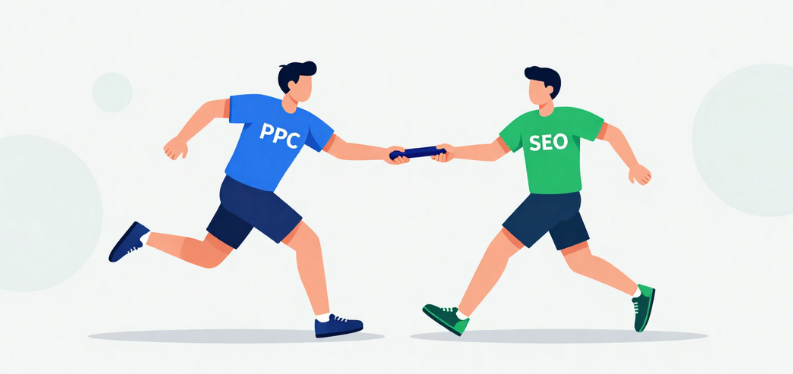
The hybrid model combines the speed of PPC with the staying power of SEO. Instead of choosing one or the other, you use both to support different stages of growth. This creates a more stable and flexible approach to marketing efforts.
PPC fills the gap while SEO builds momentum in the background. That means you can generate leads today while also building a system that reduces reliance on paid traffic over time. It’s not about overlap; it’s about timing.
The most effective businesses don’t treat these channels separately. They connect insights from both by using paid campaigns to inform SEO strategy and organic performance to improve ad efficiency. When they work together, marketing stops feeling reactive and starts becoming predictable.
Where Should Your Marketing Investments Go?
Choosing where to put your marketing efforts comes down to one simple question: do you need results now, or do you need them to last? The answer usually determines whether you lean more on PPC, SEO, or a mix of both.
If you need leads immediately, PPC usually takes priority because it delivers fast visibility. If you’re focused on long-term stability and reducing paid dependency, SEO becomes a stronger foundation. Most businesses land somewhere in the middle, where both are working together in different ways.
The key is matching the strategy to the business stage. Newer businesses often rely more on PPC to get traction, while established companies use SEO to strengthen consistency and reduce cost per lead over time. When both are aligned, your marketing efforts stop competing and start working as one system.
What Are Common Mistakes Businesses Make With Marketing Efforts?
One of the biggest mistakes businesses make is expecting every strategy to work the same way. They treat PPC and SEO like interchangeable tools, then get frustrated when results don’t match expectations.
Another common issue is impatience. Businesses often expect SEO to perform like PPC, or they assume paid ads will create long-term growth on their own. When timelines don’t match reality, they pull budgets too quickly or double down in the wrong place.
A third mistake is not measuring what actually matters. It’s easy to focus on clicks or impressions, but you should judge leads, conversions, and long-term value, not surface-level activity.
FAQs About Marketing Strategies
Are PPC and SEO both necessary for small businesses?
Yes, but not always at the same level. PPC helps small businesses get immediate visibility, while SEO builds long-term stability. Most small businesses benefit from using both in a balanced way.
How long does SEO take to show results?
SEO typically takes a few months to start showing meaningful movement, depending on competition and consistency. It builds slowly, but the results compound over time.
Is PPC worth it for long-term growth?
PPC is best for short-term gains, but it can support long-term growth when used strategically. The key is using it alongside SEO, not replacing it.
What’s the best way to split marketing investments?
There’s no universal split. It depends on your goals, budget, and timeline. Businesses focused on speed lean more on PPC, while growth-focused strategies lean more on SEO.
Can SEO replace paid ads completely?
In some cases, yes, but it usually takes time. Most businesses use both because they serve different roles in the overall marketing system.
Make the Marketing Investment That’s Right for You
Promotional investments only work when they match your goals and your timeline. PPC gives you speed, SEO builds long-term strength, and the hybrid model connects both so you’re not stuck choosing one or the other.
The businesses that grow consistently aren’t guessing. They’re aligning strategy with timing. That’s what turns marketing from a cost into a system that actually pays you back.
At Elevation Marketing™, our team helps businesses build that balance without the confusion or wasted spend. If you’re ready to make your marketing strategies work smarter, not harder. Let’s Talk.