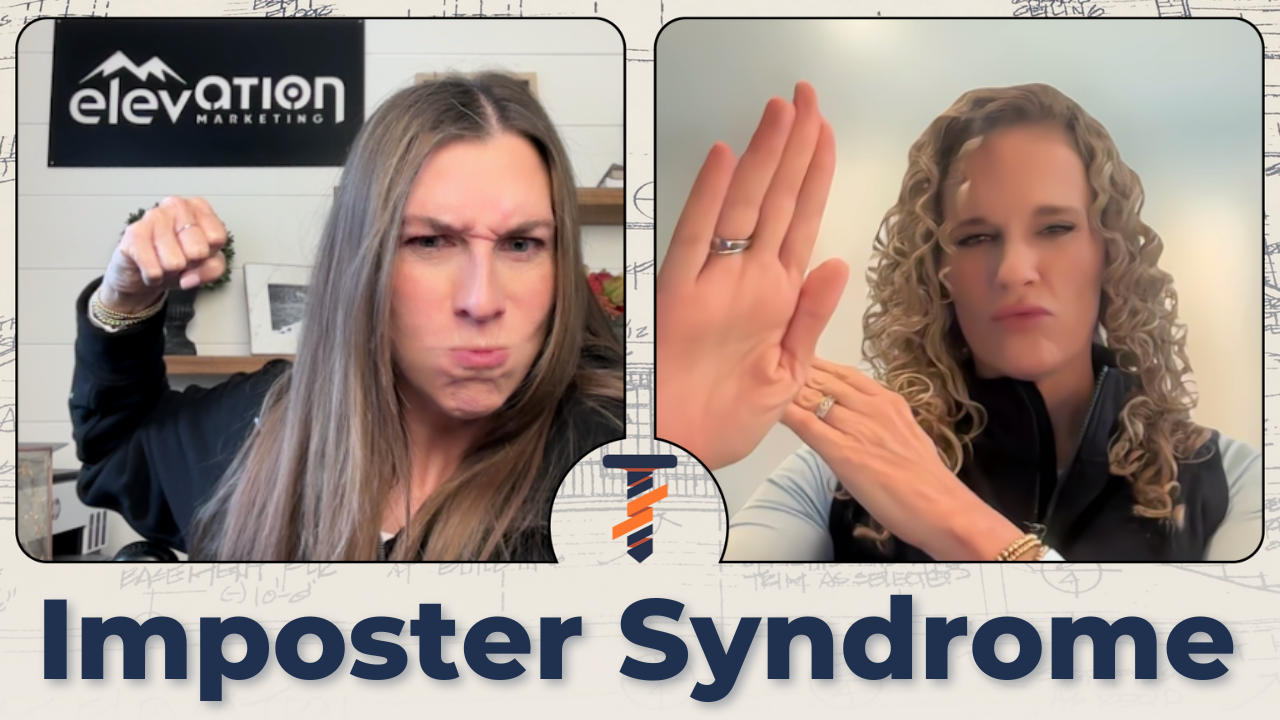
Hosts Amanda Joyce and Devon Hayes are diving into a topic nearly every business owner wrestles with at some point: imposter syndrome in business and how self-doubt can quietly shape decision-making. In this episode of Trade Secrets, brought to you by Elevation Marketing™, they explore how imposter syndrome shows up for contractors and agency leaders alike. They also cover how, when approached intentionally, it can become a powerful tool for sharper strategy, stronger marketing fundamentals, and long-term growth.
- Care to listen instead? This post is Episode 65: Imposter Syndrome Is a Superpower.
Why Does Imposter Syndrome in Business Affect So Many Contractors?
Imposter syndrome in business often appears as constant second-guessing. Contractors may wonder whether their pricing is correct, whether competitors are doing something better, or whether their marketing strategy is missing something important.
As Devon Hayes explains, this feeling is widespread among business owners who take their craft seriously. Growth requires making decisions without perfect information, and that uncertainty can create the sense that everyone else has it figured out except you.
Rather than avoiding that discomfort, Devon reframes it. When acknowledged and managed correctly, imposter syndrome can become a signal that pushes business owners to verify assumptions, seek better data, and stay engaged with what is actually working in the market.
How Can Imposter Syndrome in Business Become a Strategic Advantage?
Imposter syndrome in business can become a strategic advantage when it is reframed as healthy skepticism rather than self-doubt. By questioning assumptions, validating ideas with data, and studying competitors objectively, business owners replace uncertainty with clarity.
Instead of letting self-doubt stall decision-making, Elevation Marketing™ has leaned into what Devon describes as “healthy skepticism.” This mindset became the foundation for a company-wide initiative focused on deeper competitive analysis and long-term learning.
Rather than assuming competitors are doing things better, the team consistently asks:
- What are they actually doing?
- How long have they been doing it?
- Which fundamentals are driving results?
- Where are fundamentals breaking down behind the scenes?
This approach replaces vague insecurity with clarity. When you understand where competitors are winning and where they are not, you can make more confident, informed decisions without chasing every new trend.
Why Are Reviews a Critical Insight When Evaluating Imposter Syndrome in Business?
One of the most surprising findings centers on reviews. Across multiple markets and verticals, review consistency consistently emerged as a significant factor influencing visibility and credibility.
Rather than advanced tactics or constant content production, many high-performing businesses were benefiting from:
- A steady cadence of new reviews
- Broad participation in review requests across the team
- Strong visibility in local search and Google Local Service Ads
This discovery was affirming. It showed that many businesses are not being outperformed because competitors are “smarter,” but because they are executing key fundamentals more consistently.
For contractors experiencing imposter syndrome in business, this insight is powerful. It proves that improvement often comes from tightening basics, not reinventing everything.

How Does Competitive Research Reduce Guesswork for Contractors?
A recurring theme in Devon’s conversation with Amanda Joyce is that confidence grows through verification. Competitive research removes the mystery around why some businesses appear to be winning.
By systematically reviewing competitor websites, ads, reviews, and positioning, Elevation Marketing™ found that:
- Many competitors were not following best practices as closely as assumed
- Strong brand clarity mattered more than flashy tactics
- Consistency across platforms reduced confusion for both customers and search engines
This kind of analysis helps contractors stop comparing themselves to assumptions and start comparing against real data.

What Role Does Paid Media Play in Reinforcing or Reducing Self-Doubt?
Amanda shares insights from paid media analysis that reinforced this theme. In many markets, contractors were spending significant amounts per click but sending traffic to pages that were not designed to convert.
Common issues included:
- Driving service-based traffic to homepages
- Generic ad copy that failed to address homeowner pain points
- Limited focus on post-click experience
These findings highlighted a vital lesson tied directly to imposter syndrome in business: poor results do not always mean poor decisions. Sometimes the structure around those decisions needs refinement.
Practical Ways Contractors Can Use Imposter Syndrome Productively
Contractors looking to turn self-doubt into forward motion can start by focusing on controllable actions:
- Validate assumptions with competitor research instead of guessing
- Strengthen review systems across the entire team
- Clarify brand messaging so customers instantly understand who you are and what you do
- Measure real outcomes instead of relying on surface-level metrics
Each of these steps replaces uncertainty with insight.
FAQs About Imposter Syndrome in Business
Q: What Is Imposter Syndrome in Business?
A: Imposter syndrome in business is the ongoing feeling that you are not as capable or knowledgeable as others perceive you to be, even when your results, experience, or track record suggest otherwise. It often shows up as self-doubt around decision-making, fear of being “found out,” or the belief that competitors have everything figured out while you are just getting by. For contractors and business owners, this can surface when setting prices, hiring team members, investing in marketing, or evaluating growth opportunities.
Q: Is Imposter Syndrome Common Among Contractors?
A: Yes, imposter syndrome is prevalent among contractors, especially those who are growing or scaling their businesses. Many contractors are experts in their trade but are forced to make complex decisions around marketing, hiring, leadership, and finances without formal training in those areas. When competitors appear more visible online or seem more established, it can amplify self-doubt, even though many of those competitors are struggling with the same challenges behind the scenes.
Q: Can Imposter Syndrome in Business Be Helpful?
A: When approached intentionally, imposter syndrome in business can be helpful rather than harmful. Self-doubt can become healthy skepticism that drives learning and improvement. Instead of assuming competitors are “better,” business owners can use that feeling as motivation to analyze what is actually working, test strategies, and validate decisions with real data.
Q: How Can Marketing Data Help Reduce Imposter Syndrome?
A: Data replaces assumptions with clarity. Competitive research shows what competitors are actually doing, not just what appears impressive on the surface. When contractors see that many “top” competitors are consistently executing basics like reviews, brand clarity, and follow-up, confidence grows. Measuring real performance helps business owners trust their decisions and move forward without constantly questioning whether they are falling behind.
Ready to Turn Insight Into Action?
If you are tired of guessing and want clarity around what actually works, Elevation Marketing™ helps contractors move forward with confidence. From competitive research and review strategy to paid media and SEO fundamentals, our experienced team focuses on building momentum through proven, transparent processes.
Contact Elevation Marketing™ today to learn how a more innovative strategy and more precise data can help you elevate your business without second-guessing every move.