
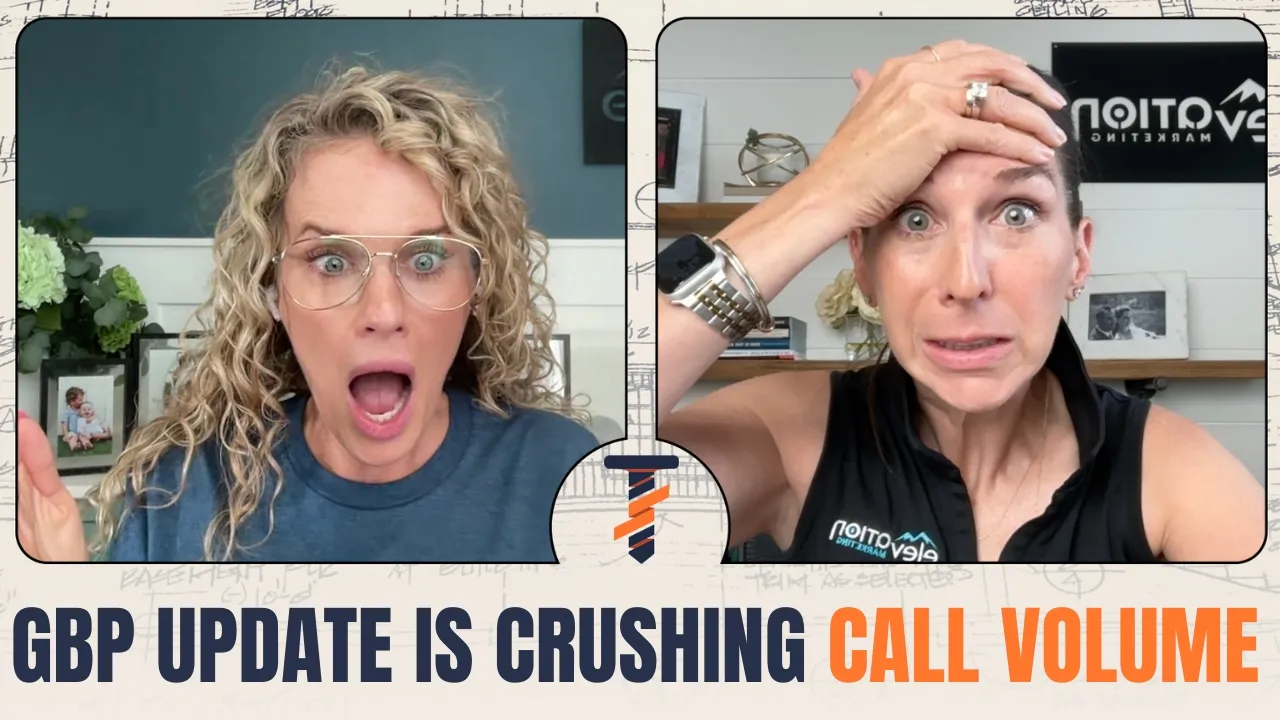
Why Did Roofing Call Volume Suddenly Drop From Google?
Some roofers may be losing calls because Google removed the direct Call button from certain mobile local-pack results, adding another step before homeowners can contact them. However, ranking changes, seasonality, paid competition, website visibility, and tracking problems may also contribute to the decline.
At Elevation Marketing™, we started hearing the same thing from roofing contractors across multiple markets in late June: “It feels like somebody flipped a switch.”
Within a matter of days, roughly eight to 10 of our roofing clients reached out asking some version of the same question: What happened to our calls?
At first, seasonality seemed like an obvious possibility. We were heading into the Fourth of July. Homeowners travel. Demand fluctuates.
But then we started looking at the search results.
Something had changed.
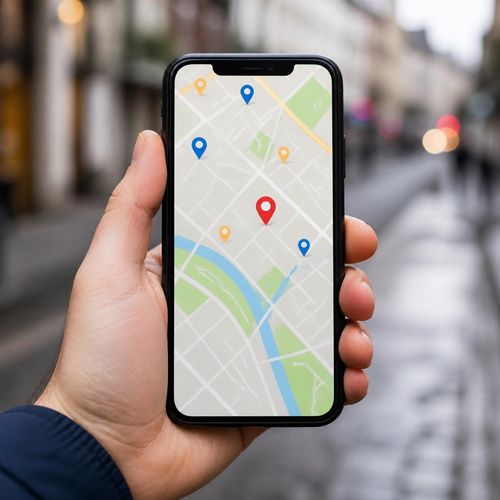
For roofing searches we tested, Google had removed the prominent Call button that previously appeared beside businesses directly in the local three-pack on mobile. A homeowner could still click into the individual Google Business Profile and find the phone option, but Google had added another step between the search and the call.
Meanwhile, paid placements above the local results continued giving homeowners highly visible ways to call.
That sounds like a small user-interface change. For a contractor who depends heavily on calls from Google Maps and the local pack, it may be anything but small.
🎧 Care to listen instead? This post is inspired by our Trade Secrets podcast episode about the Google Business Profile update affecting roofing call volume.
What Changed With Google Business Profiles for Roofers?
For years, one of the most valuable pieces of digital real estate for a roofing company has been Google’s local three-pack.
Search something like “roofer near me” or “roofing contractor,” and Google may display a map followed by several local roofing companies. Ranking there matters because these aren’t casual searches. Someone searching for a roofer is often trying to hire one.
On mobile, Google historically made the next step incredibly easy: tap Call.
During our testing this summer, that changed for roofing searches.
We began seeing roofing contractors in the local pack without that immediate Call button. The phone option was still available after opening the business’s full profile, but the one-tap action directly from the initial local results was gone.
Interestingly, we weren’t seeing the same layout across every contractor category.
We could perform a siding-contractor search and still encounter the Call button, then conduct a roofing-contractor search in the same market and see a different experience.
That’s an important distinction.
We are not claiming Google eliminated phone calls from Google Business Profiles. It didn’t.
What we’re observing is an additional layer of friction between some roofing searches and the phone call.
And friction matters.
Why Can One Missing Button Have Such a Big Impact?
Put yourself in the homeowner’s shoes.
This isn’t an SEO person studying the search engine results page. It’s somebody whose roof is leaking—or whose insurance company just told them they need a new roof—or who simply knows it’s time to start getting estimates.
They’re looking for the easiest credible next step.
As Amanda put it on the podcast, think about someone like her mom searching for a roofer. She’s probably going to take the path of least resistance.
If a paid listing at the top of the page has strong reviews and a big, obvious way to call, while an organic local listing requires another click before she can reach the same action, where is she more likely to go?
That’s why we’ve been paying such close attention to this change.
A single additional click sounds trivial when you’re sitting in a marketing meeting.
Multiply it across thousands of searches, and it may not be trivial at all.
Is Google Trying to Force Roofers to Pay for Leads?
This is where we need to separate what we can prove from what we think may be happening.
Google has not announced that it removed or deemphasized organic calling options for roofers specifically to force contractors into paid advertising.
So we’re not going to tell you that’s a fact.
But we’d be lying if we said the current search experience doesn’t make us raise an eyebrow.
During the same period that we observed less direct calling from roofing businesses in the local three-pack, we’ve also seen Local Services Ads and traditional Google Ads occupying extremely valuable mobile real estate—with prominent opportunities for homeowners to take action.
Our interpretation?
Google is continuing to make paid visibility increasingly difficult for contractors to ignore.
That’s our observation, not a confirmed statement of Google’s intent.
And there’s another piece of this puzzle worth watching.
Google has officially begun transitioning Local Services Ads into Google Ads. The first phase of that migration started in August 2026 for select U.S. home and storefront service advertisers, including roofing contractors.
In other words, the Google advertising ecosystem for home services is undergoing significant change at the same time we’re seeing changes in how local organic results are presented.
Exactly where this ends up is still unclear.
As we said on the podcast: It’s the Wild West, people.
Your GBP Still Matters—Maybe More Than Ever
The wrong takeaway from all of this would be:
“Well, Google screwed up the local pack, so why bother with my GBP?”
No.
Quite the opposite.
Your Google Business Profile remains an extremely important representation of your business in local search. Google says local results are primarily determined by relevance, distance, and prominence, and it specifically identifies complete business information, reviews, and positive ratings among the signals that can help local visibility.
So control the things you can control.
At Elevation Marketing™, we tell contractors to think about their Google Business Profile almost like a miniature website.
Don’t create it, verify it, and then forget that it exists.
Give it signs of life.
That means regularly adding authentic photos, keeping business information accurate, managing and responding to reviews, and making sure the profile actually represents the services your company provides.
And none of that requires hiring a photographer every Tuesday.
Your crews are already generating the content you need.
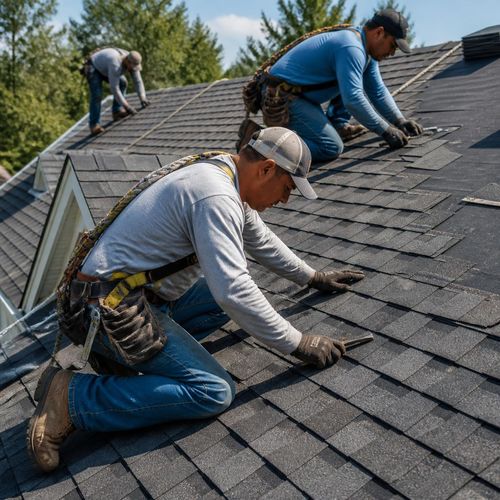
Stop Overthinking Your Job-Site Photos
We recently encouraged a roofing client to post more job-site photos, and they raised a legitimate concern:
What if somebody in the photo hasn’t clipped into a harness yet? What if something gets posted that appears unsafe or creates an OSHA concern?
That’s understandable.
But it doesn’t mean you have to stop taking job-site photos.
Have the crew take a photo during lunch with the house in the background. Take a picture before anyone gets on the roof. Get the wrapped truck in the shot. Take a crew selfie while everyone is standing safely on the ground.
We’ve watched roofing companies perform extremely well in local search while consistently posting real photos featuring actual crew members, branded shirts and trucks.
And those photos aren’t just useful for Google.
They’re useful for humans.
A homeowner doesn’t necessarily care about seeing 47 nearly identical close-ups of flashing.
As Amanda put it:
“Nobody cares about your flashing.”
They want to see the people who may show up at their house.
Will your crew protect the landscaping? Will they leave the property clean? Do these look like real people working for a real local company?
That’s marketing material you already have sitting on somebody’s phone.
Don’t let it die in the truck.
Reviews Matter, But Don’t Chase an Unproven “Review Velocity” Formula
Reviews deserve particular attention right now, but we need to correct an important distinction from our podcast discussion.
Google explicitly confirms that review count and review score factor into local search ranking and that more reviews and positive ratings can help a business’s local ranking.
What Google does not publicly provide is a formula telling contractors that obtaining X number of new reviews per week will increase rankings.
We discussed “review velocity” on the podcast because we’ve been paying close attention to the consistency with which roofing companies earn reviews, and we believe ongoing review generation is worth prioritizing.
But we cannot independently verify a specific July 2026 Google update that suddenly increased the ranking weight assigned to review velocity.
So don’t turn this into another SEO gimmick.
Don’t decide that Google wants exactly three reviews every Tuesday.
Instead, build a legitimate process for continually asking real customers for reviews.
That’s good for search visibility, and it’s good for the homeowner deciding between you and three competitors.
It can also be encouraging for newer roofing companies.
If you’re sitting at 50 reviews while the giant competitor down the street has 600, don’t assume the game is over. You can’t instantly manufacture years of history, but you can consistently create great customer experiences and ask those customers to share them.
That’s something tangible your team can work on today.
Don’t Ignore What Happened to Your Website at the Same Time
There’s another reason we don’t want roofing companies blaming every June traffic or lead decline on the missing Call button.
Google also rolled out a June 2026 spam update from June 24 through June 26.
That timing overlaps remarkably closely with when many contractors started telling us something felt wrong.
But here’s another place where precision matters.
Google confirmed the spam update.
Google did not say in its announcement that this was specifically an “AI content update” targeting contractors who built large numbers of AI-generated service-area pages.
So if an agency tells you, “Google confirmed that its June update penalized AI roofing websites,” that’s overstating what Google actually announced.
What we can tell you is what we’ve been warning contractors about for a long time:
If your website is filled with interchangeable content that could belong to any roofing company in America simply by swapping the city and company name, you have a problem.
AI has made that problem dramatically easier to create at scale.
The Problem Isn’t Using AI. It’s Publishing Content With Nothing to Say.
We’re seeing contractors get pitched a version of the same product over and over:
Forget the website you’ve invested in for the last five years. We’ll build you a brand-new AI website. We’ll generate hundreds of pages. It’ll be ready almost immediately.
Please be careful.
AI can be a fantastic tool.
But pressing a button 200 times does not magically create 200 pieces of expertise.
If you have a page about roofing in a particular city, tell us something a roofer who actually works there would know.
- Show a real project.
- Include your project photos.
- Quote the person on your team who knows the subject.
- Discuss the roofing systems you recommend there and why.
- Explain the permitting headache everybody in that county hates.
- Have an opinion.
That’s the material AI can’t manufacture for your business because it doesn’t have your experience.
Your website should sound like the salesperson you want sitting in a homeowner’s living room, not like every other roofer downloaded the same robot.
As Amanda explained in the episode, your website is a walking, talking salesperson.
It should reinforce the things your team says during an actual sales conversation: why you’re different, what you’ve learned, what you recommend, and why a homeowner should trust you.
If you’ve leaned too heavily on generic AI content, you don’t necessarily need to burn the website down.
Start improving it.
Add your intellectual property. Add your experts. Add firsthand observations. Add projects. Add original photography. Add actual opinions.
Make the page impossible for another roofing company to steal simply by changing the logo.
That human-first approach is also at the center of how Elevation Marketing™ creates content for contractors. AI can support the process, but real expertise, human judgment, and ongoing refinement are what build lasting authority.
What Should Roofing Contractors Do Right Now?
If your organic calls have dropped, don’t panic and don’t immediately assume your marketing agency broke something.
Start diagnosing.
1. Look at the actual search results on a mobile device.
Search the terms homeowners use to find you. Look at roofing searches from your market and see what actions Google displays in the local results, paid ads and your full Business Profile.
2. Compare call and GBP performance before and after late June.
Don’t rely on how things “feel.” Look at your call-tracking and Business Profile performance data and determine where the decline actually occurred.
3. Make sure your GBP information is complete and accurate.
Review your primary business information, categories, services, hours, phone number, website and service information. Google’s own guidance recommends maintaining complete and detailed information to help it understand your relevance to a local search.
4. Build a sustainable review process.
Don’t chase an arbitrary review-velocity number. Consistently ask legitimate customers for reviews and respond to the reviews you receive.
5. Get real job-site content onto your profile.
Create a simple internal process for crews to send usable photos. Wrapped trucks, branded shirts, crews, completed projects, and safe job-site imagery can all provide authentic evidence of the company behind the listing.
6. Audit your website for mass-produced content.
If you’ve published dozens or hundreds of generic AI-generated city, service or blog pages, evaluate them critically. Ask the uncomfortable question: Could I change the company name and give this page to another roofer?
If the answer is yes, it needs work.
7. Add human expertise instead of simply adding more words.
Original project examples, photographs, expert quotes, local knowledge, informed opinions, and firsthand recommendations make your content genuinely yours.
8. Don’t depend on one source of leads.
Google can change the interface tomorrow. That’s the larger lesson here. Your organic visibility, Google Business Profile, Local Services Ads, paid search, website, reviews, and brand should work together rather than leaving your pipeline dependent on one button Google controls.
9. Review your local service ads.
If paid placements are becoming more prominent, make sure your account is properly set up and actively managed.
Review your budget, lead quality, answer rate, booked jobs, and return on investment. Before simply increasing your spending, understand what can hurt your Local Services Ads visibility.
We don’t know whether Google will keep this exact local-search experience, expand it, test something else or eventually walk parts of it back.
That’s precisely why contractors need a marketing ecosystem rather than a single trick.
At Elevation Marketing™, we look at these numbers alongside our clients because diagnosing a lead decline takes shared context, transparent data, and ongoing refinement, not a canned report.
Frequently Asked Questions About Google Business Profiles
Did Google remove the call button from roofing Google Business Profiles?
Not entirely. In searches we’ve tested, Google has removed the direct Call action from some roofing businesses in the initial mobile local-pack results. The call option remains available after opening the full Business Profile. The exact presentation can vary by search, market, category, device and Google’s ongoing interface changes.
Is the missing call button causing roofing call volume to drop?
We have observed sharp call-volume declines across multiple roofing clients during the same period that we observed the local-pack interface change. However, we cannot independently establish that the interface change alone caused those declines. Seasonality, ranking changes, advertising competition, website visibility and other factors can also affect call volume.
Did Google confirm that the June 2026 spam update targeted AI content?
No. Google confirmed that a spam update ran globally from June 24 through June 26, 2026, but its public status announcement does not specifically identify AI-generated content as the target of the update.
Does Google use reviews to rank Google Business Profiles?
Yes. Google states that review count and review score factor into local ranking and that more reviews and positive ratings can help local rankings. Google does not publish a specific review-frequency formula that businesses should follow.
Should roofers stop using AI to create website content?
No. The issue isn’t simply whether AI was involved. Contractors should be wary of publishing large amounts of generic, interchangeable content with no original expertise, projects, photographs, opinions, or useful local information. AI should support your expertise rather than replace it.
Are Local Services Ads moving into Google Ads?
Yes. Google says it began transitioning select U.S. home and storefront service advertisers—including roofing businesses—from Local Services Ads into Google Ads in August 2026, with additional migrations planned through late 2026 and 2027.
Treat Your Google Business Profile Like a Sweet Little Baby
Yes, that’s really where we landed on the podcast.
Google is being squirrely.
So treat your GBP like a tiny, demanding baby.
Feed it.
Give it attention.
Swaddle that thing and drop some photos in there.
More seriously: keep it accurate, give homeowners authentic information about your company, continue earning legitimate reviews, and make sure it reflects a business that is alive, active, and doing great work in its market.
At the same time, don’t destroy a strong website because somebody promised you an AI easy button.
The companies that continue investing in real expertise, original content, real projects, strong brands, and multiple ways for homeowners to find them will be in a much better position to weather whatever Google changes next.
And Google will change something next.
If your roofing calls dropped this summer, compare what you’re seeing with the Elevation Marketing™ team. We’ll work alongside you to follow the data, diagnose what changed, and refine the entire visibility system instead of chasing a temporary fix.
That is how we build digital foundations that last.