
What Should You Know About Contractor Marketing Agency Red Flags?
This episode explains how to recognize contractor marketing agency red flags hidden behind bold promises. You will learn how to evaluate rankings, guarantees, lead reports, and contract terms before hiring an agency.
Executive Summary
Contractors should look beyond rankings and marketing jargon. A good agency provides clear services, useful reporting, measurable goals, and marketing assets the contractor owns.
🎧 Care to Listen Instead? This post covers Episode 72: Are You Buying Results, Rankings, Software, or Just Better-Sounding SEO? of the Trade Secrets: Contractor Marketing podcast.
Devon Hayes and Amanda Joyce explain how to separate real marketing strategy from polished sales language.
Why Do Contractor Marketing Agency Red Flags Matter?
Contractors receive constant pitches promising more leads, higher rankings, and online dominance. These offers can be tempting when the business needs new jobs quickly.
However, a service can sound advanced while providing less work or targeting results the contractor already has. At Elevation Marketing™, Devon and Amanda encourage contractors to slow down and determine exactly what each agency is selling.
Modern Agency Pitch Jargon vs. Reality
Marketing agencies often use impressive-sounding terms to promote their services. Before signing a contract, take time to understand what these phrases actually mean and ask for specific examples of what is included.
“Google Maps Dominance”
This may only mean improving visibility near your physical location. Ask whether the promise covers the local 3-pack, the Maps tab, or both.
You should also request the target keywords and geographic radius. “Dominance” means little without a clear definition.
“Guaranteed Rankings”
An agency may guarantee rankings for phrases that few homeowners use. Ask whether the promise covers valuable service keywords that could produce qualified leads.
“Lead-Generation System”
The agency may count every call or form submission as a lead. Ask whether its reports exclude spam, job seekers, vendors, and people outside your service area.
“Proprietary Software”
Software can organize data, but a dashboard isn’t a strategy. Ask what an actual person will review and improve each month.
“Full-Service SEO”
Some packages only manage a Google Business Profile or basic local SEO. Ask whether the SEO services include content, technical work, website updates, reporting, and ongoing planning.
Understanding the difference between marketing language and actual deliverables makes it easier to compare agencies. The best marketing partner will explain their process clearly, set realistic expectations, and show how its work supports your long-term business goals.
The Truth About “Google Maps Dominance”
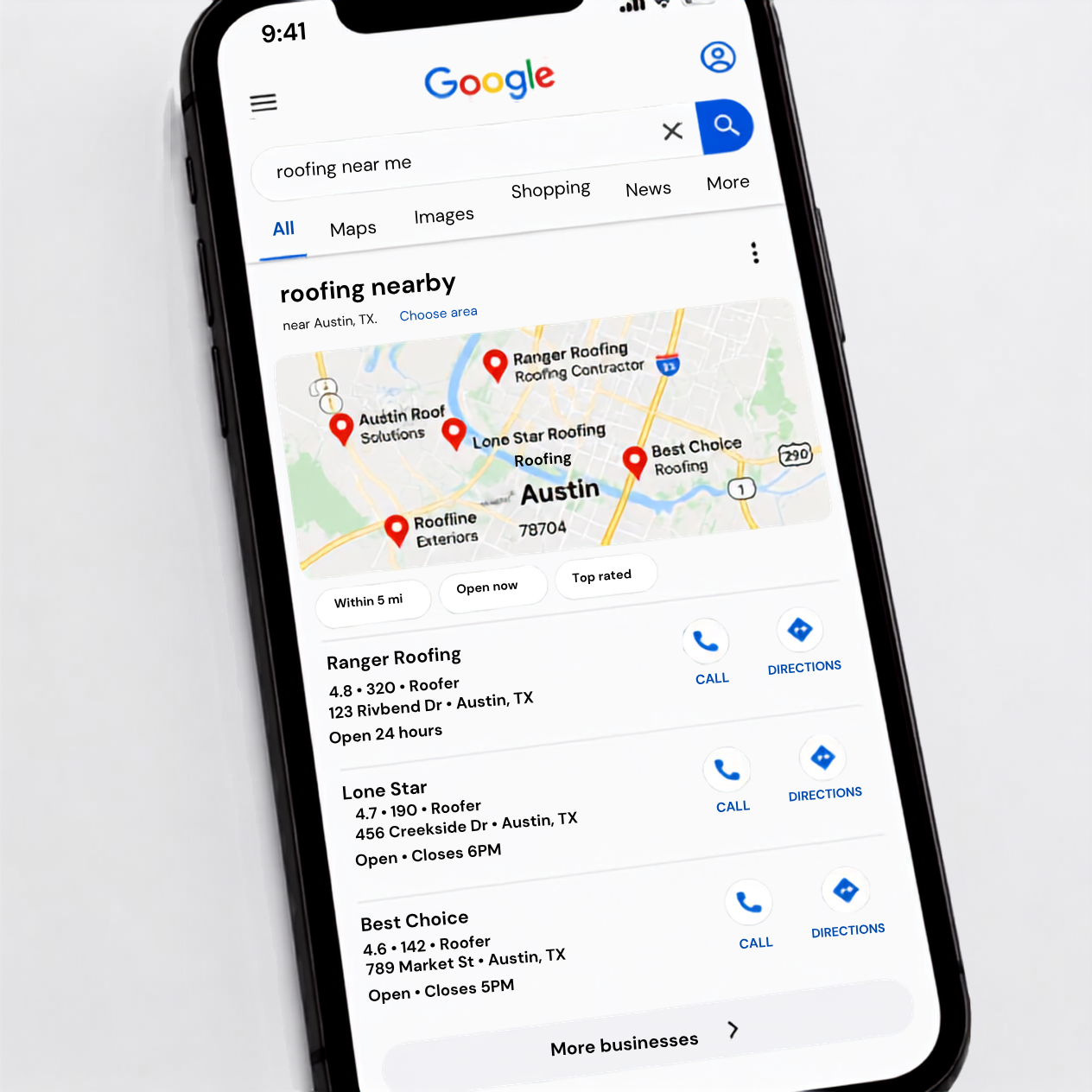
The local 3-pack appears within Google’s main search results, while the Maps tab is a separate area. A contractor may appear in different positions in each place.
This distinction matters because many homeowners never open the full Maps tab. A high position there doesn’t guarantee equal visibility in the local 3-pack.
Google states that local rankings are mainly based on relevance, distance, and prominence. No agency can remove location from the process or promise the same position to every searcher.
Reviews, accurate business information, and local connections can strengthen visibility. Contractors trying to reach distant communities may also need trust signals tied to those areas.
4 Essential Contract Questions Every Contractor Must Ask
1. What Business Outcome Are You Promising?
Determine whether the agency is selling rankings, leads, appointments, revenue, or profit. These are different stages of the sales process. A ranking isn’t a lead, and a lead isn’t a sold job. Ask how the agency will connect its work to meaningful results.
2. What Work Will You Perform Each Month?
Ask the agency to separate strategy, implementation, software, and reporting. A report shows what happened but doesn’t prove meaningful work occurred. The agency should explain its monthly activities and how it will adjust them. Marketing cannot remain effective if the plan never changes.
3. Is This One Channel or a Complete Strategy?
An agency may specialize in SEO, paid advertising, social media, email, or reputation management. Specialization is fine, but you should know whether the service improves one channel or coordinates the larger plan. Customers may find you through search and then check your reviews, website, and social media. These channels should support one another.
4. What Am I Expected to Do?
Your team may need to answer calls quickly, request reviews, share photos, approve content, or provide project details. These actions can affect marketing performance. Ask how your responsibilities affect any guarantees. Confirm that your team can meet the requirements before signing.
Red Flags and Fine-Print Caveats
Watch for the Null-and-Void Trap
Agencies sometimes attach strict conditions to their guarantees. A ranking promise might become invalid if the contractor fails to collect a set number of reviews each week.
Reviews matter, but this condition gives the agency a way out of its promise. Ask exactly what cancels the guarantee and what happens if one requirement is missed.
Other contractor marketing agency red flags include:
- The sales pitch promises broad visibility, but the contract only covers your physical location.
- Terms such as “dominance” and “growth” are never defined.
- Every call or form submission counts as a lead.
- Reports focus on rankings without tracking booked jobs.
- The contract doesn’t explain who owns the website, accounts, content, or data.
Ask what happens when the relationship ends. Your content, website improvements, campaign history, and organic assets shouldn’t disappear when you leave.
Checklist: How to Choose a True Marketing Partner
A trustworthy agency should study your business before recommending services. Look for a partner that:
- Reviews your market, pipeline, budget, and goals.
- Connects its work to qualified leads and business outcomes.
- Defines the services, keywords, channels, and locations included.
- Separates genuine prospects from spam and poor-quality inquiries.
- Explains what its team will do and what it needs from yours.
- Gives you access to your accounts, content, website, and data.
- Adjusts the strategy when results or market conditions change.
- Measures booked jobs and revenue instead of relying on vanity metrics.
One agency doesn’t need to perform every marketing activity. However, your primary partner should understand the complete plan and help each channel support the others.

FAQs About Contractor Marketing Agency Red Flags
How Can Contractors Verify Reported Leads?
Request access to the calls, recordings, and form submissions behind every reported lead. An agency should review inquiries and remove spam, job seekers, vendor pitches, existing customers, and contacts outside its service area. Ask how leads are labeled and whether you can inspect the supporting data yourself at any time.
Is Hiring a Single-Channel Agency a Mistake?
Hiring a single-channel agency isn’t automatically a mistake. A skilled specialist may improve SEO, paid search, social media, or another weak area. However, that work should support a broader marketing strategy. Make sure someone coordinates every channel so your messaging, goals, data, and customer experience remain consistent over time.
What Should Contractors Own After a Contract Ends?
Contractors should retain ownership of their website, domain, content, analytics, advertising accounts, campaign history, business listings, call tracking data, and creative assets. They should also keep administrator access to each platform. Confirm these rights in writing before signing so changing agencies doesn’t erase your progress or interrupt your marketing.
How Elevation Marketing™ Helps Contractors Build Lasting Visibility
Elevation Marketing™ begins by examining the contractor’s market, pipeline, goals, and current marketing. Our team then identifies weak areas and prioritizes work that can produce qualified opportunities. The relationship emphasizes transparency and collaboration instead of vague promises.
Better-sounding SEO isn’t always better SEO. Contractors must look beyond rankings, dashboards, branded systems, and guarantees to determine whether an agency supports real growth. Define every promise before signing. Choose a partner that communicates clearly, measures meaningful results, and builds assets that retain value over time.
Ready to Take the Next Step?
Are you reviewing a confusing proposal or questioning your current results? Contact Elevation Marketing™ for an honest assessment of your marketing strategy.