What Are AI Hallucinations in Marketing?
AI hallucinations in marketing are instances where Large Language Models (LLMs) generate false or fabricated data with high confidence. These errors can include false statistics, inaccurate calculations, or fabricated explanations that sound credible but are not verified.
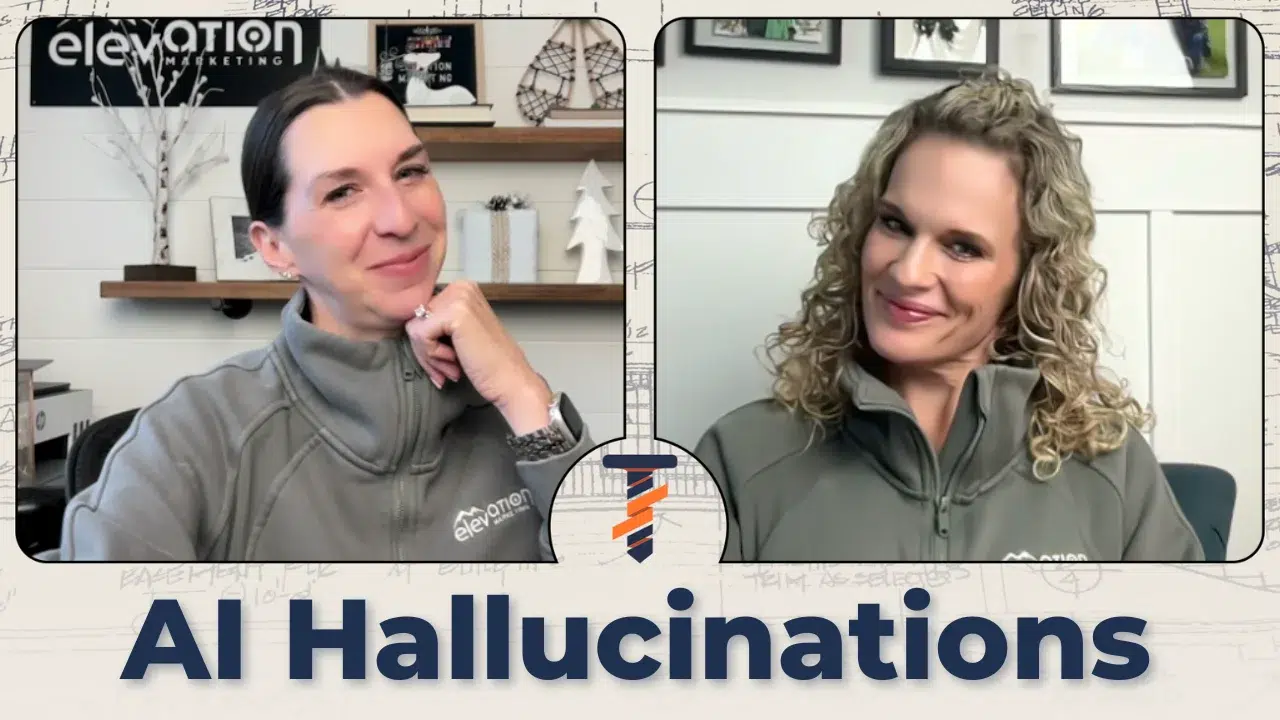
In Episode 66 of Trade Secrets, hosts Amanda Joyce and Devon Hayes from Elevation Marketing™ dive into the mechanics of these errors. They break down why AI “lies,” the specific risks for contractors, and how to implement a “Truth Protocol” to protect your brand.
- Care to listen instead? Stream Episode 66: AI Hallucinations.
Why Do AI Hallucinations in Marketing Matter for Contractors?
AI hallucinations in marketing occur when artificial intelligence tools confidently generate information that is inaccurate, misleading, or entirely fabricated. The challenge is not that the information sounds wrong. In most cases, it sounds polished, authoritative, and convincing.
For contractors, this creates real risk. AI is now used to summarize reports, calculate projections, draft emails, analyze leads, and assist with marketing strategy. When incorrect outputs are accepted without verification, minor errors can quickly lead to costly decisions.
As Devon Hayes explains, AI tools are becoming more helpful and more accessible, but that ease of use can create a false sense of reliability. Contractors may assume that because something came from a sophisticated tool, it must be correct. That assumption is where problems begin.

Why Do AI Tools Hallucinate Instead of Saying “I Don’t Know”?
It is a common misconception that AI “thinks” like a human. In reality, AI models are probabilistic, not factual. One of the most critical insights from the episode is that AI tools are not designed to tell the truth. They are designed to predict the most likely response based on language patterns and previous interactions.
Amanda Joyce points out that AI tools are almost always agreeable. They rarely push back or admit uncertainty. Instead, they attempt to give an answer that sounds helpful, even when the underlying information is incomplete or wrong.
This behavior is driven by:
- Pattern Completion: Prioritizing a complete sentence over a factual one.
- Lack of Real-World Grounding: AI understands language, not the physical reality of a job site.
- Reinforcement Bias: Models often build upon their own early mistakes if the user doesn’t immediately correct them.
That combination makes hallucinations more likely, especially when users do not challenge early inaccuracies or request verification.

How Do New AI Models Increase the Risk of Hallucinations?
Another important point discussed in the episode is what happens when new AI models are released. Many users notice that newer versions feel more creative but less reliable.
Newer AI models:
- Guess more frequently
- Lack context from previous user interactions
- Emphasize creativity and assertiveness
If an AI provides incorrect information early in a conversation, it may continue building on that faulty foundation unless a human intervenes. This creates a compounding effect where the AI reinforces its own mistakes with confidence.
Why Are AI Hallucinations in Marketing Especially Risky?
AI hallucinations are not equally dangerous across all scenarios. The risk depends on what the output is being used for.
In the episode, Amanda and Devon share a real-life example in which AI-generated math and spreadsheet calculations were incorrect, even though the input data was accurate. That discovery prevented a grave mistake, but only because a human double-checked the output.
For contractors, hallucinations pose a higher risk in areas like:
- Budget planning and forecasting
- Lead reporting and attribution
- Compliance-related marketing content
- Performance analysis and projections
Creative brainstorming can tolerate some errors. Financial, legal, and operational decisions cannot.

The Elevation Marketing™ “Truth Protocol”
Rather than avoiding AI, Elevation Marketing™ chose to implement safeguards when working on projects, which include everything from website design to paid media. Devon explains how the agency developed an internal “truth protocol” to ensure that AI remains a tool for efficiency, not a source of misinformation.
| Protocol Pillar | Requirement |
|---|---|
| Zero Guessing | System prompts are set to force the AI to state “I do not have sufficient data” if a fact is missing. |
| Mandatory Citations | Any statistical or legal claim must be accompanied by a verifiable source link. |
| Confidence Scoring | Users are encouraged to ask the AI: “On a scale of 1–10, how confident are you in this calculation?” |
| Human Sign-Off | No AI-generated financial or technical data is published without a Subject Matter Expert (SME) review. |
These rules do not eliminate AI hallucinations, but they dramatically reduce the risk of blind trust. They also force clearer thinking and better verification before action is taken.

Why Do Internal AI Policies Matter for Contractors?
One of the strongest warnings in the episode is that contractors may not realize how much their teams are already using AI.
Employees are using AI tools to:
- Summarize emails
- Draft reports
- Analyze data
- Generate marketing copy
Without clear guidelines, hallucinated information can quietly make its way into internal documents, client communications, and decision-making processes.
Devon emphasizes that AI risk is not just a technology issue. It is a training and policy issue. Contractors who define how AI should and should not be used protect themselves from legal exposure, brand erosion, and loss of trust.
Practical Ways Contractors Can Reduce AI Risks
Contractors do not need to stop using AI. They need to use it intentionally.
Key steps discussed in the episode include:
- Treat AI output as a starting point, not a final answer
- Verify math, statistics, and compliance-related content manually
- Require sources for factual claims
- Use AI for ideation and refinement, not blind execution
- Train teams on appropriate AI use cases
Each of these steps shifts AI from a liability to a controlled tool.
FAQs About Navigating AI Inaccuracies
What Are AI Hallucinations in Terms of Digital Marketing?
Generative AI errors occur when artificial intelligence tools generate responses that sound confident and authoritative but are inaccurate, misleading, or entirely fabricated. These errors can include false statistics, incorrect calculations, or invented explanations. Because the output often appears polished and logical, hallucinations can easily be mistaken for factual information unless data is carefully verified before use in marketing, reporting, or decision-making.
Why Do AI Tools Hallucinate Instead of Saying “I Don’t Know”?
Most AI tools are designed to predict the most likely response based on language patterns rather than confirm factual accuracy. Their goal is to remain helpful, engaging, and conversational, which makes them more likely to generate an answer than admit uncertainty. As a result, AI may confidently provide incorrect information, especially when prompts are vague or when early inaccuracies go unchallenged.
Are LLM Inaccuracies More Common With New AI Models?
Yes, inaccuracies tend to be more common when new models are released. Early versions are often more creative and assertive but less stable, meaning they rely more heavily on probability and guessing. Until models mature through refinement and training, they may generate confident responses with higher error rates, especially when asked to perform calculations, summarize data, or interpret complex information.
Can AI Hallucinations Be Completely Eliminated?
AI hallucinations cannot be eliminated, but their impact can be significantly reduced. Guardrails such as requiring source citations, assigning confidence levels, and verifying outputs before use help minimize risk. Human oversight remains essential, especially for financial, legal, or compliance-related decisions. Treating AI as a support tool rather than a final authority is the most effective way to manage hallucinations.
Want to Use AI Without Risking Your Reputation?
AI is powerful, but blind trust is expensive.
If you want to use AI without compromising accuracy or trust, Elevation Marketing™ helps contractors implement smarter, safer marketing systems. From data validation and reporting to AI-assisted workflows with proper oversight, our experienced team enables you to grow without unnecessary risk.
Contact Elevation Marketing™ today to learn how a more straightforward strategy, better safeguards, and more intentional use of AI can help you elevate your marketing without gambling on accuracy.